Analyzing Player Behavior in Idle Games to Create Better Game Promotions
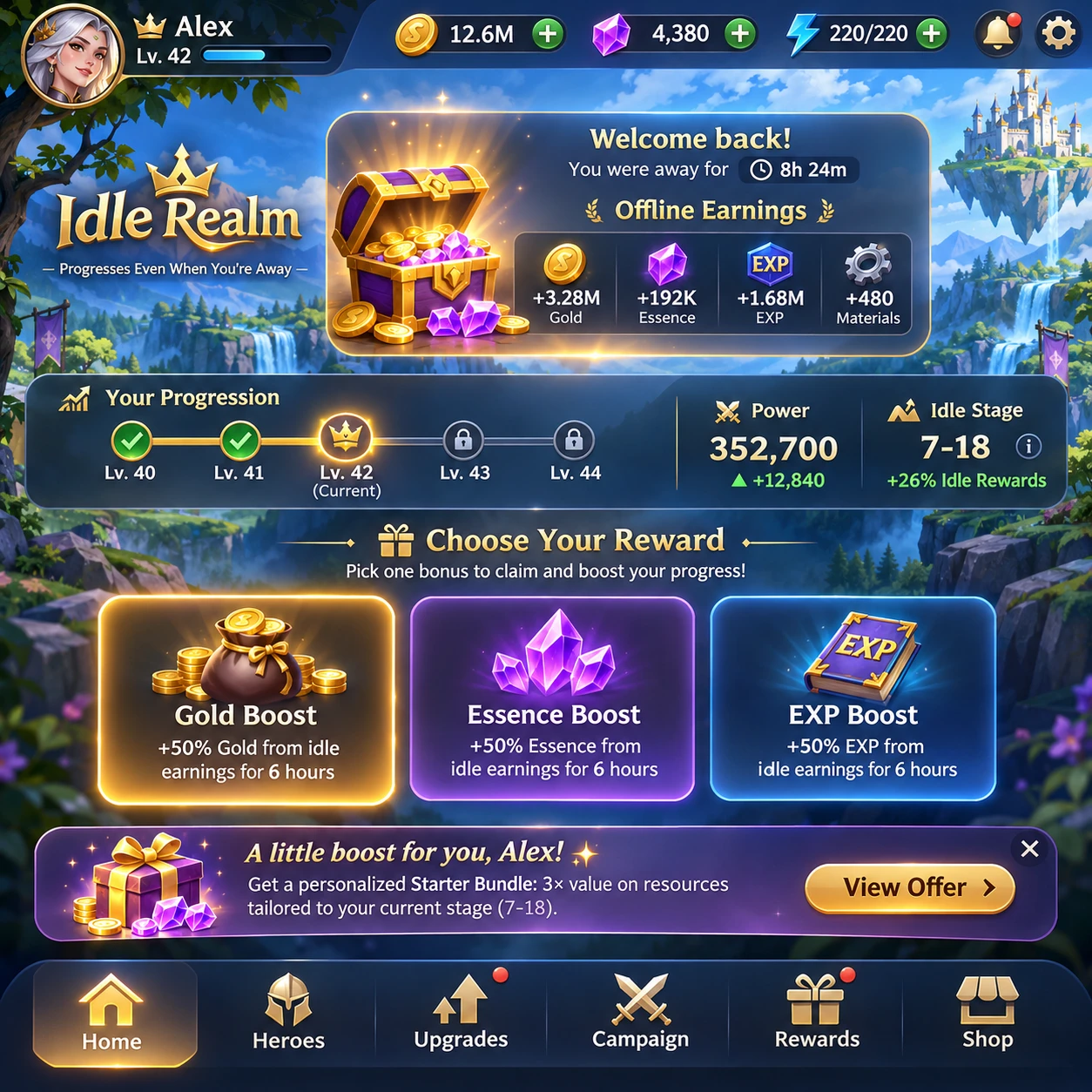
Idle games are built around a distinctive rhythm: players make progress during short visits, leave the game running, then return to collect rewards or make their next decision. That rhythm creates useful clues about player behavior, but a click or login alone rarely explains what someone wants.
For game teams, the goal is to connect those clues to promotional offers that fit the player’s current experience. A well-timed reward can make a return visit feel worthwhile; a poorly matched offer can interrupt play or make progression feel pressured. The difference starts with understanding what to observe, what it might mean, and what a promotion can reasonably do.
What Makes Player Behavior in Idle Games Distinct?
Player behavior in idle games is shaped by progress that continues between sessions. Short active visits, offline earnings, and repeated return visits make engagement patterns different from games that depend on long, continuous play.
A player may open an idle game for only a few minutes, collect accumulated resources, upgrade a producer, and leave again. That brief session can represent healthy engagement if it fits the game’s intended loop. Session length on its own is therefore a weak measure of interest.
Instead, interpret activity in context. Consider how often players return, whether they claim offline rewards, and what they do after collecting them. A return followed by a meaningful upgrade may signal that progression is motivating. A return that ends immediately after reward collection might simply reflect a routine check-in, or a lack of appealing next steps.
Idle games also create natural pauses. Players may wait for a new milestone, a resource threshold, or a limited-time game event. Promotions should respect these pauses rather than treating every gap as a problem to fix. A reminder or offer can support a player’s next decision, but it should not imply that ordinary offline time is a failure.
Which Player Signals Are Worth Observing?
The most useful player signals connect a specific behavior to a possible promotional decision. Track progression, session patterns, feature use, and responses to rewards together, rather than treating any single action as proof of motivation.
- Progression signals: Record milestones reached, upgrade choices, resource bottlenecks, and time between stages. A player approaching a milestone may respond to a relevant event reward, while someone who has just reached it may need a different next goal.
- Session patterns: Observe return frequency, time between visits, and actions taken after login. Separate quick collection visits from sessions that include several upgrades or feature interactions.
- Feature use: Note whether players engage with prestige systems, quests, collections, timed events, or social features when those are available. Feature participation can help identify which kinds of promotional content are relevant.
- Reward response: Compare whether players claim, ignore, or use in-game rewards. Check what they do afterward. A claimed reward that leads to no further interaction may be less useful than one that supports a chosen upgrade or event activity.
Use clear event definitions and consistent time windows. For example, measure the share of eligible players who claim a reward within 24 hours, then compare their subsequent progression with a suitable comparison group. That does not prove the reward caused a change, but it gives the team a better starting point than counting claims alone.
Keep data collection proportionate. A useful analysis can rely on gameplay events and aggregated patterns; it does not need invasive personal assumptions. Give players clear information about relevant data practices, and follow applicable privacy requirements.
How to Group Players by Motivation and Play Style
Player segmentation groups people by observed patterns that can guide relevant promotions. Treat segments as flexible descriptions of recent behavior, not fixed labels or assumptions about who players are.
A practical approach is to segment by what players do and where they are in progression. For example, a player who regularly checks offline earnings may benefit from a simple return reward, while someone who often joins timed events may be more interested in event-specific goals. A player who experiments with upgrades may respond to a promotion that helps them explore a new system.
Useful working segments might include:
- New explorers: Players still learning core systems. Keep promotions simple and explain the reward clearly.
- Steady collectors: Players who return to claim resources but make few other moves. Offer an optional next step, such as a small quest or milestone reward.
- Progression planners: Players who regularly invest resources in upgrades or prestige. Match promotions to the stage they are working toward.
- Event participants: Players who repeatedly engage with game events. Highlight relevant event rewards without sending the same message outside the event context.
- Recently inactive players: Players whose return pattern has changed. Consider a low-pressure welcome-back message, while allowing for ordinary breaks.
Segments should update as behavior changes. Someone may join events one week and focus on offline collection the next. Avoid assigning segments using sensitive or speculative traits; a short, observable history is usually more useful for promotion decisions and less likely to produce stereotyping.
Matching Promotions to Player Context
Match a promotion to the player’s current progression stage, demonstrated interests, and recent activity. The offer should make sense in the moment and give a clear choice about whether to engage.
For a new player, an introductory reward can support learning if it explains how to use the reward and does not crowd out the core tutorial. For an established player near a milestone, a milestone-linked bonus may feel more relevant than a generic offer. During a limited-time event, an event reward can help participants pursue that event’s goals, provided its terms and timing are clear.
Use a simple context check before showing an offer:
- Stage: What progression milestone or game system is the player currently engaging with?
- Interest: Which features have they chosen to use recently?
- Timing: Is this a natural point in the session, such as after collecting idle earnings or completing an event task?
- Choice: Can the player understand the offer and decline it without losing ordinary progress?
Promotional offers can include in-game rewards, optional event participation, or clear information about available game content. The right format depends on the game and its rules. A reward that helps a player pursue an existing goal may be more fitting than one that introduces an unrelated task.
Avoid inferring too much from one action. Ignoring an offer does not necessarily mean the player dislikes the reward; they may be busy, saving resources, or simply uninterested at that time. Keep promotions relevant, and let repeated behavior—not a single response—inform future choices.
Balancing Promotion With a Positive Player Experience
Promotions support a positive player experience when they are relevant, clearly explained, and paced around gameplay. They undermine trust when they interrupt routine actions, repeat too often, or make players feel that normal progression depends on accepting an offer.
Place promotional messages at natural breaks, such as after a collection or at the end of an event task, rather than blocking a core action. Explain what the player receives, any requirements, and when an offer expires. If a promotion involves a purchase or other commitment, make the terms easy to understand before the player acts.
Frequency controls matter. Set limits on how often a player sees the same promotion, and suppress messages that no longer apply. A player who has already claimed an event reward should not continue seeing a prompt to claim it. Similarly, a return offer should stop being relevant once the player is active again.
There is a trade-off between visibility and interruption: showing more offers may create more chances to notice them, but it can also make the game feel commercial rather than rewarding. Use opt-outs or notification controls where appropriate, and judge success alongside negative signals such as dismissals, reduced engagement, or complaints. Promotions should support player choice, not exploit impatience or pressure people who have taken a break.
Turning Observations Into Better Promotion Decisions
Turn behavior analysis into better promotions by testing a clear hypothesis, comparing relevant outcomes, and refining the offer over time. Track whether a promotion helps the intended player group without damaging retention or the quality of the gameplay experience.
Start with a specific question: for example, do players who regularly participate in timed events respond better to an event-linked reward than to a general return message? Define the audience, the offer, and the measurement period before launch. Where practical, compare the promotion with a control group that does not see it. This helps distinguish the effect of the offer from ordinary changes in player activity.
Review more than acceptance. Useful measures include offer views, claims, follow-up gameplay, progression after the reward, return visits, and opt-outs. Interpret each metric with care: a high claim rate may not be positive if players leave immediately afterward or report that the offer was confusing.
Keep a simple decision record for each promotion: the behavior observed, the audience selected, the offer shown, and the results reviewed. Use that record to adjust audience rules, timing, reward relevance, and frequency. If a pattern is unclear, collect more evidence or test a smaller change instead of making a broad assumption about player motivation.
Over time, this feedback loop helps teams create game promotions that fit idle-game rhythms. The aim is a useful match between player context and offer: one that supports progression, respects a player’s choice to return or step away, and gives the team evidence to improve the next decision.