The Psychology Behind Casual Gaming Addiction: Why You Can't Stop at "Just One More Level"
You open a match-3 game to kill five minutes. Thirty minutes later, you're still there, just one level away from a new reward. Sound familiar? You're not weak-willed — you're human. Casual games are engineered with a precise understanding of how the brain works, and once you see the mechanics clearly, the whole experience shifts from mysterious compulsion to something you can actually manage.
What Makes Casual Games Different from Traditional Gaming
Casual games — the mobile puzzles, idle clickers, match-3 titles, and browser-based games — are uniquely designed to fit into the gaps of daily life. Unlike console games that demand hours of committed attention, casual games are built around short sessions, simple mechanics, and zero upfront cost. That combination makes them far more accessible, and far easier to return to compulsively.
Traditional games often require investment: you need context, a controller, sometimes a subscription. Casual games remove every barrier. They live in your pocket, launch in seconds, and reward you within the first 30 seconds of play. That frictionless entry is by design.
The free-to-play model also changes the psychological contract. There's no sunk-cost pressure from a $60 purchase — which paradoxically makes it easier to keep returning without conscious justification. You're not "playing" so much as just... checking in. And those check-ins accumulate.
The Dopamine Loop: Your Brain on Casual Games
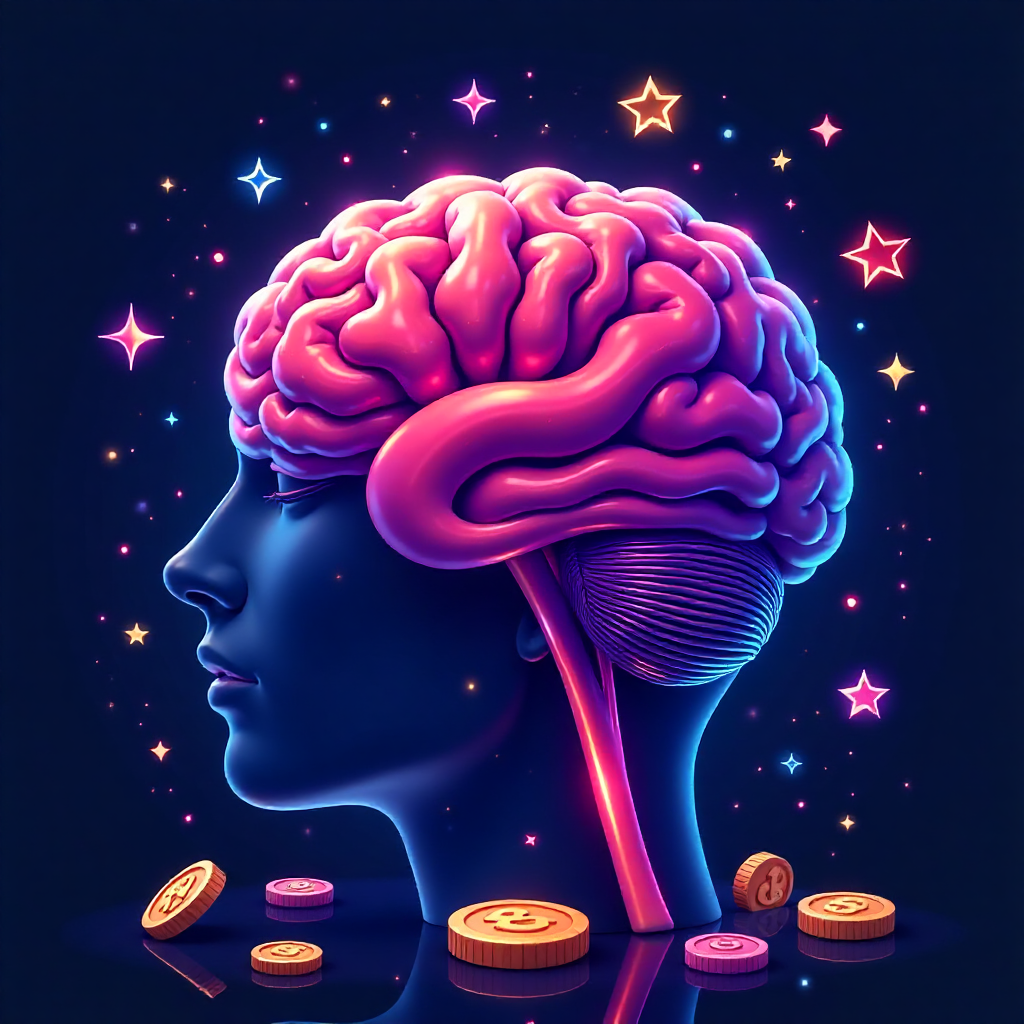
The dopamine reward loop is the core mechanism behind why casual games feel so compelling. Dopamine isn't just the "pleasure chemical" — it's more accurately the anticipation chemical. Your brain releases it when you expect a reward, not just when you receive one.
Every time you're one move away from clearing a level, your brain is already flooding with dopamine in anticipation. When you succeed, there's a brief spike of satisfaction. Then the loop resets — and your brain immediately starts seeking the next hit. This cycle is self-reinforcing. The more you play, the more your neural pathways associate the game with reward, making the urge to return stronger over time.
What makes casual games particularly effective at exploiting this is pacing. Levels are calibrated to be challenging enough to feel meaningful but short enough to complete quickly. You rarely fail so hard that you quit — you fail just enough to try again. That tension between near-miss and success is neurologically potent.
Variable Reward Schedules: The Slot Machine Effect
Unpredictable rewards are more compelling than predictable ones — this is one of the most replicated findings in behavioral psychology, first demonstrated by B.F. Skinner in the 1950s. Casual games use this principle aggressively through what's known as a variable reward schedule.
When a reward might appear — a rare power-up, a bonus chest, a mystery loot drop — the brain treats every action as a potential jackpot. This is exactly how slot machines work. The unpredictability doesn't reduce engagement; it amplifies it. Players keep pulling the lever (or swiping the board) because this time might be the big one.
In practice, this shows up as:
- Mystery boxes or loot crates with randomized contents
- Spin-the-wheel daily bonuses
- Power-ups that appear randomly mid-level
- Event rewards that vary based on performance
The compulsion loop this creates isn't a bug — it's the feature. Game designers understand that certainty breeds boredom. Variability breeds engagement. Understanding this doesn't make the pull disappear, but it does help you recognize when you're being played as much as you're playing.
Progression, Streaks, and the Fear of Missing Out
Progression mechanics — level-ups, achievement badges, daily streaks — exploit two powerful psychological forces: the satisfaction of completion and the anxiety of loss. Together, they create a surprisingly durable hook.
Daily streaks are particularly clever. Once you've maintained a 14-day streak in a word game or puzzle app, breaking it feels like a genuine loss — even though nothing tangible disappears. This is loss aversion in action, a cognitive bias where losses feel roughly twice as painful as equivalent gains feel good. The streak itself becomes the thing you're protecting, not the game you're playing.
Limited-time events work the same way. A special level that disappears in 48 hours isn't just an opportunity — it's a threat. Miss it, and it's gone. That urgency bypasses rational thinking and triggers a reflexive "I should do this now" response.
Level systems tap into something slightly different: the near-completion effect. When a progress bar is 90% full, your brain treats finishing it as almost obligatory. Designers know this and often place natural stopping points just past a milestone — so you're always a little further in than you planned to be.
Social Mechanics and the Need for Validation
Social features in casual games aren't just extras — they're psychological amplifiers. Leaderboards, friend challenges, and shareable achievements tap into some of the most fundamental human motivations: status, belonging, and recognition.
Seeing your name near the top of a leaderboard triggers a genuine sense of social status, even within a trivial context. Conversely, seeing a friend score higher than you activates mild competitive anxiety — and competitive anxiety is a powerful motivator to keep playing. The game becomes a social arena, and social arenas are hard to walk away from.
Shareable achievements serve a dual purpose. They reward the player with a moment of social validation and simultaneously advertise the game to their network. When a friend posts "I just reached Level 50!" the subtext your brain reads is: this game is worth playing, and playing it makes you look accomplished.
This social layer is why casual games spread so effectively through friend groups. The psychology isn't manipulative in a sinister sense — humans genuinely are social creatures who find meaning in shared experiences. But knowing that these mechanics are deliberate helps you evaluate whether you're playing for fun or for approval.
When Fun Becomes a Habit: Recognizing the Line
Casual gaming becomes problematic when it shifts from a chosen activity to a default response — something you do not because you want to, but because you feel restless without it. The distinction matters.
Healthy casual gaming often resembles a flow state: you're absorbed, time passes pleasantly, and you finish feeling relaxed rather than depleted. That's a legitimate form of mental rest. The trouble starts when the game is no longer relaxing — when you feel anxious about a broken streak, irritated at interruptions, or guilty about time spent — but keep playing anyway.
A few honest questions worth asking yourself:
- Do you play to unwind, or to avoid something else?
- Do you feel worse after a long session than before it?
- Has your screen time crept up without a conscious decision?
- Do you feel genuine distress when you can't play?
Answering yes to one of these occasionally is normal. Answering yes to most of them consistently suggests the habit has outgrown its original purpose. That's worth paying attention to — not with alarm, but with curiosity.
Playing Smart: Enjoying Casual Games Without the Grip
The goal isn't to stop playing — it's to play on your own terms. A few practical approaches grounded in behavioral psychology can help you keep the fun without ceding control.
Set session boundaries before you open the app. Decide in advance: "I'm playing for 15 minutes." This sounds obvious but works because it shifts the decision point from reactive ("should I stop now?") to proactive ("I already decided"). Your future self in the middle of a compelling level is a bad decision-maker. Your present self, before the dopamine loop starts, is a much better one.
Turn off streak notifications. Streak reminders are specifically designed to trigger loss aversion. Disabling them doesn't end the streak — it just removes the anxiety that makes the streak feel coercive rather than fun.
Play actively, not passively. Idle games and auto-play features are designed to keep you engaged with minimal input — which means minimal enjoyment too. If you're not actively engaged, you're probably just feeding the habit loop. Choosing games that require genuine skill and attention tends to produce more of that satisfying flow state and less of the hollow "why am I still here" feeling.
Understanding how game designers use variable rewards, social validation, and progression mechanics doesn't diminish the fun — if anything, it deepens your appreciation for well-crafted games. The best casual games are genuinely clever pieces of design. Playing them with awareness means you get to enjoy the craft without being unconsciously steered by it.
Frequently Asked Questions
Is casual gaming addiction a real psychological condition?
"Gaming disorder" was recognized by the World Health Organization in 2019 as a diagnosable condition, but it applies to a small minority of players and requires significant functional impairment. Most people who feel compelled by casual games are experiencing normal responses to deliberate design — not a clinical disorder. The distinction matters: one requires professional support, the other requires self-awareness and habit adjustment.
Why do mobile games feel more addictive than console games?
Mobile games are always with you, launch instantly, and are designed for sessions as short as 60 seconds. That constant availability means the trigger (boredom, a free moment, mild stress) is almost always met with immediate opportunity. Console games require more deliberate setup, which creates a natural friction that limits impulsive play.
Can casual gaming ever be genuinely stress-relieving?
Yes — and research supports it. Short sessions of low-stakes casual games can reduce cortisol levels and provide genuine cognitive rest, particularly for people in high-demand jobs. The key is intentional play: choosing to play as a relaxation tool rather than reaching for the phone automatically. When the activity is chosen rather than compelled, the stress-relief benefits are real.
What age groups are most susceptible to casual gaming habits?
Adolescents are more vulnerable due to still-developing impulse control and a heightened sensitivity to social validation. But casual gaming habits are common across all adult age groups — particularly among adults 25-45 who use mobile games as stress relief during commutes or downtime. Older adults are also a fast-growing demographic, drawn to puzzle and word games for cognitive engagement.
How do game developers intentionally design for engagement?
Game studios employ behavioral psychologists and UX researchers specifically to optimize engagement. Techniques include calibrated difficulty curves, variable reward timing, social comparison features, and notification systems timed to moments of likely boredom. This isn't secret — it's a well-documented field called gamification, and understanding it is genuinely useful for any player who wants to stay in control of their habits.